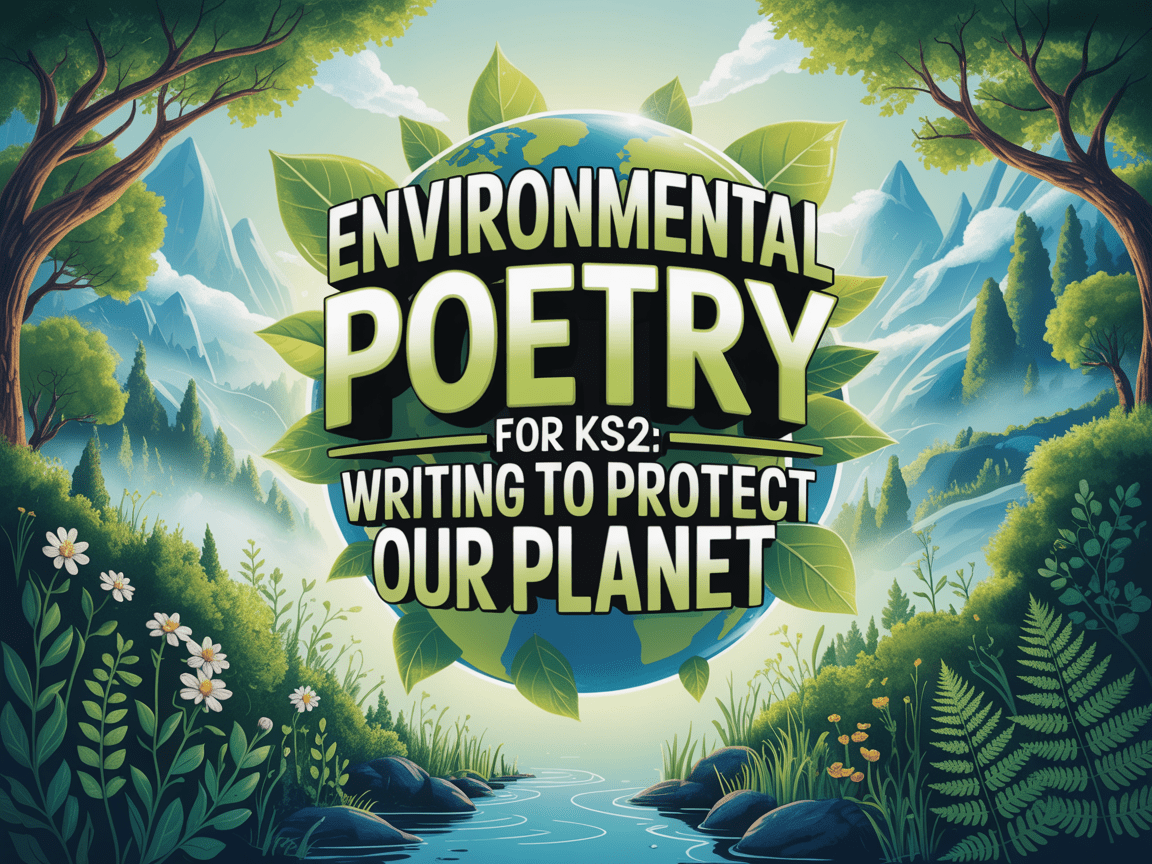
🌍 Environmental Poetry for KS2: Writing to Protect Our Planet ✍️🌱

🌟 Why Explore Environmental Poetry in KS2?
As a children’s poet who has worked in hundreds of schools across the UK, I’ve seen how powerful poetry can be when it connects with real-world themes. One of the richest topics to explore is the environment.
Environmental poetry KS2 activities give pupils the chance to:
-
Build ambitious vocabulary linked to science and geography topics 🌍
-
Practise figurative language, imagery, and personification ✍️
-
Develop empathy and responsibility for the world around them 🌱
-
Create purposeful writing that links to PSHE, assemblies, and school eco-projects 👩🏫
👉 In my Poetry Days in schools and online workshops, I regularly use themes to inspire writing and performance. If you’d like your pupils to experience this live, book a Poetry Day ➡ Poets in Schools – Ian Bland.

Great for teachers looking to save time!
📝 Six Example Environmental Poems for KS2
1. Haiku (The River)
Water rushes fast,
Whispering through rocky banks,
Life flows everywhere.
🔗 Related: Haiku Poems KS2
2. List Poem (Save the Planet)
I will save…
The forests tall,
The oceans deep,
The polar bears,
The air we keep.
🔗 Related: List Poems KS2

3. Free Verse (The Rainforest Speaks)
I am the rainforest,
breathing for you.
Each tree a lung,
each branch a voice.
Cut me down,
and you silence yourself.
🔗 Related: Free Verse Poetry KS2
4. Cinquain (Endangered)
Tiger,
Silent, striped,
Hunting, waiting, vanishing,
Struggling for survival,
Creature.
🔗 Related: Cinquain Poems KS2
5. Personification Poem (The Earth)
I cry with storms,
I shiver with snow,
I smile with sunshine,
I whisper with wind.
I am your Earth —
take care of me.
🔗 Related: Personification Poetry KS2
🔗 Geography Poems KS2 🔗 KS2 Poetry Vocabulary Mats 🔗 KS2 Poetry Comprehension Worksheets
🔗 Best Poems For Children To Learn And Perform KS2

Get yourself a signed book!
🎉 Environmental Poetry Activities for KS2
💡 Vocabulary Harvesting
Before writing, create a word bank of rich scientific and descriptive language. Pupils might include “pollution, ecosystem, renewable, fragile, preserve, thrive.” This scaffolds ambitious vocabulary while supporting EAL and SEND learners.
💡 Nature Walk Writing
Take pupils outside (playground, school field, or local park). Ask them to collect sensory impressions — what they see, hear, smell, and feel. Back in class, turn these into descriptive or free verse poems.
💡 Poetry Protest Banners
Groups create short, powerful verses to use as eco-slogans. Perform these as chants or echo poems:
“Save the seas, save the sky,
We need the Earth, don’t let it die!”
💡 Collaborative Class Poem
Give the class a repeated starter like “I will save…” or “I am the Earth…”. Each child adds one line. The result is a long, collective piece that works beautifully in assemblies.
💡 Cross-Curricular Science Link
After a science lesson on habitats, food chains, or the water cycle, ask pupils to write poems using that knowledge. This reinforces scientific concepts through creative expression.
🔗 Related: Science Poetry KS2
💡 Performance Poetry
Encourage choral reading and performance. Give groups roles (Ocean Voice, Forest Voice, Animal Voice) so children learn how to bring tone and intonation into their delivery.
🔗 Related: Performance Poetry KS2 🔗KS2 Frozen Inspired Winter Poems 🔗 Best Funny Poems KS2
 👩🏫 Teacher Pedagogy Notes
-
Word banks and scaffolding: Support vocabulary development before drafting.
-
Modelling: Show how figurative language and scientific vocabulary can sit together.
-
Differentiation: Provide writing frames for reluctant writers while extending confident pupils with free verse challenges.
-
Purposeful writing: Link poems to assemblies, displays, and eco-projects so children know their work has an audience.
-
Curriculum coverage: Activities meet objectives in English (figurative language, performance), science (plants, animals, habitats), and PSHE (care and respect).

🌟 Final Thought
Environmental poetry KS2 is a powerful way to bring together literacy, science, and children’s natural sense of wonder. It encourages empathy, builds vocabulary, and gives writing real purpose.
👉 If you’d like to see how these ideas come alive in the classroom, I’d love to visit your school for a Poetry Day or connect with your pupils through an online workshop.
Book a Poetry Day ➡ Poets in Schools – Ian Bland

Earth Day is coming soon on the 22nd April!