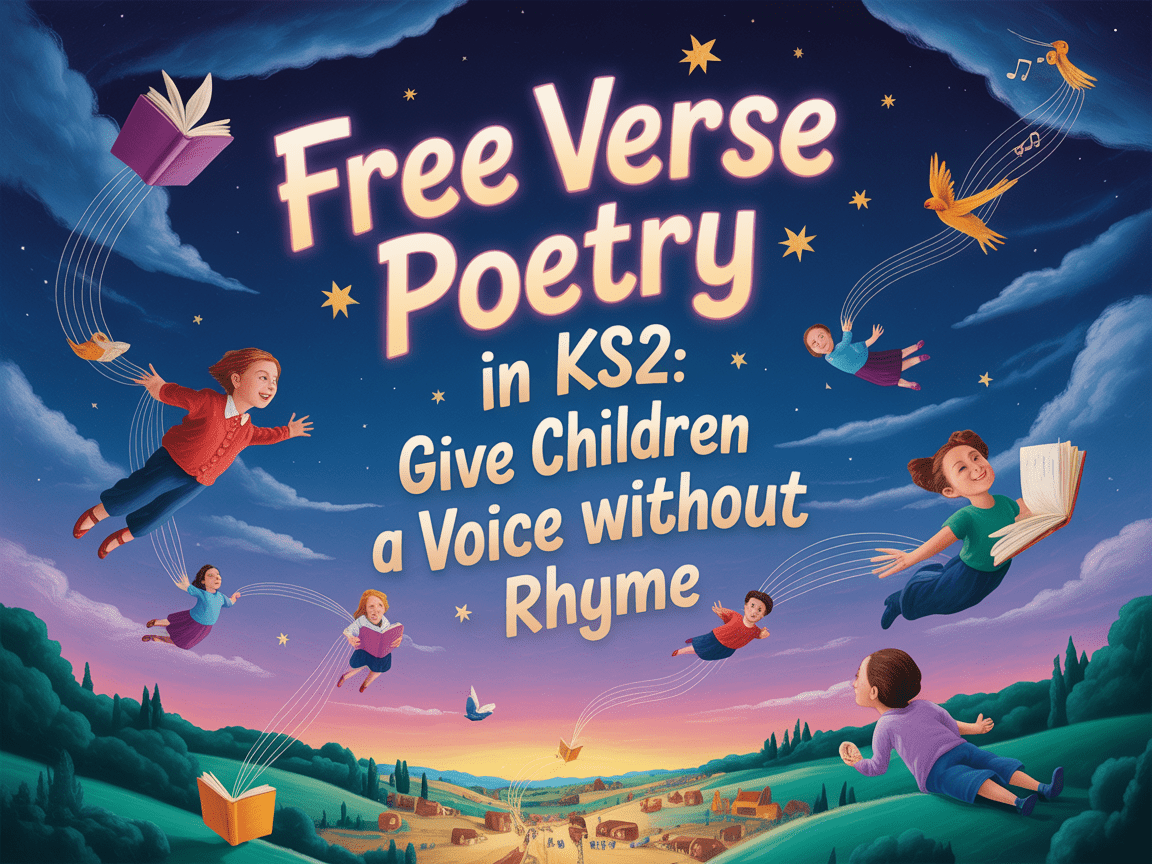
Free Verse Poetry in KS2: Give Children a Voice Without Rhyme

Introduction 🌟
Free verse removes the pressure of rhyme and strict patterns, letting children focus on voice, imagery, and line breaks. It’s perfect for KS2 because it encourages confident choices with vocabulary, builds sentence fluency, and supports performance. If you’ve got reluctant writers, free verse often unlocks them.
🔗 Related: The Ultimate Guide to Teaching Poetry in KS2
🔗 Related: Fun Writing Warm-Ups for KS2
If you think your class would love a poetry session like this, you can book an Online Workshop or Poetry Day anytime.

Great for teachers looking to save time!
What Is Free Verse? ✏️
Free verse poems:
-
Don’t follow a set rhyme scheme or syllable count.
-
Use line breaks and white space to control pace and emphasis.
-
Rely on strong images, precise verbs, and sound (rhythm, repetition, alliteration).
-
Read naturally—like heightened speech.
🔗 Try next: Powerful Verbs Through Poetry and Teaching Rhyme and Rhythm in KS2 Made Easy
🔗 Teaching Figurative Language Through Poetry 🔗 Christmas Similes and Metaphors KS2

Why Teach Free Verse in KS2? 🚀
-
Removes barriers: no rhyme = more ideas, faster drafting.
-
Builds vocabulary: encourages precise nouns/verbs and figurative language.
-
Improves fluency: line breaks help children hear cadence and emphasise key words.
-
Cross-curricular: brilliant for History, Science and PSHE topics.
🔗 Related: Narrative Poems for KS2 • Poems to Learn and Perform 👉 Performance Poetry in Primary Schools
🔗 The Ultimate Guide To Teaching Poetry KS2

Get yourself a signed book!
Mini Lesson (20–30 minutes)
Objective: Write a short free verse poem using imagery and purposeful line breaks.
-
Model (5 min) – Show a 6–8 line teacher example (see below). Think aloud: Why this verb? Why break here?
-
Collect Images (5 min) – On whiteboards, list nouns, strong verbs, sensory details for a shared theme (e.g., Playground Rain / Roman Soldier / Volcano).
-
Draft (10 min) – Children write 6–10 lines. Encourage enjambment (run-on lines) and repetition for effect.
-
Perform (5–10 min) – Quick read-throughs in pairs or small groups. Ask: Which line landed best? Where could a new break add impact?
Three Model Free Verse Examples (Originals) 📝
Rain on the Playground
The sky buttons open
and the playground
shines—
a hundred tiny mirrors
kicking back our faces
in the puddles.
Match Day
Boots breathe mud.
The ball skids,
a white comet
dragging our cheers
across the touchline.
The Roman Shield
Red as warning,
heavy with stories—
I lift it,
and hear the clang
of other mornings.
Use these to highlight imagery, precise verbs, line length, and where sound changes pace.
Simple Scaffolds & Starters 🧱
-
Repetition frames: “I remember… / I remember…” • “Because… / Because…” • “This is the… / This is the…”
-
Sentence stems: “Under the…”, “Between… and…”, “I hold…”, “The sound of…”
-
Line-break menu:
-
Break before a powerful noun/verb for emphasis
-
Isolate a single-word line to slow the reader
-
Use short–long–short lines to vary pace
-
🔗 Follow-up: Cinquain Poems for KS2 (for structure after freedom)
Figurative Language Toolkit 🎨
-
Simile: The corridor is like a river at hometime.
-
Metaphor: My pencil is a sprinting cheetah.
-
Personification: Windows yawn open after lunch.
-
Alliteration/Onomatopoeia: Lunchboxes clatter; lids click shut.
Post a quick word-bank on the board (powerful verbs, sensory nouns, figurative starters) to accelerate drafting.
Differentiation & Support
-
EAL / emerging writers: use photo prompts; offer a 6-line frame with two optional repetition lines.
-
Greater depth: require at least two imagery devices and varied line lengths; challenge them to remove 20% of words for precision.
-
SEND: scribe from spoken ideas; let pupils arrange pre-written strips into their poem, then tweak.
Quick Assessment Checklist ✅
Pupil-friendly success criteria:
-
I chose precise verbs and clear images.
-
My line breaks help meaning and pace.
-
I used at least one figurative device.
-
My poem reads fluently out loud.
-
I edited for clarity (cut extra words).
(Stick this on the board or print as a mini ticket.)
 Cross-Curricular Free Verse Ideas 🌍
-
Science: Volcano / Evaporation / Forces
-
History: Roman soldier / Viking longship / WW2 evacuee
-
Geography: River journey / Coastline / Weather
-
PSHE/Wellbeing: Anxiety as weather / Friendship as a bridge
🔗 Pair with: List Poems for KS2 (to gather ideas first) and Univocalic Poems (for wordplay practice).
Troubleshooting (Common Issues) 🧰
-
It reads like prose. → Shorten lines, isolate key words, add a repeated phrase.
-
Too many adjectives. → Swap in strong verbs; use precise nouns.
-
No imagery. → Add one simile/metaphor and one sound detail.
-
Monotone performance. → Mark breath marks (/) and bold a chosen power line.
 Publish & Perform 🎤
Create a gallery wall with printed poems and QR codes linking to audio recordings. Try a mini open-mic at the end of the week—great for confidence and fluency.
Want a live boost for your poetry unit?
-
Book a Poetry Day In Your Primary School! (in person across the UK).
-
Join an Online Poetry Workshop for KS1 & KS2.