👨👩👧 Family Poems KS2 | Funny, Relatable & Performance Ideas



Families are at the heart of children’s lives — and they make brilliant material for poetry! From mums and dads to grans and siblings, family poems are often funny, sometimes touching, and always relatable.
Writing family poems KS2 gives children the chance to explore relationships, humour, and everyday situations in a creative way. These poems also link perfectly with PSHE, wellbeing, and assemblies.
If your pupils enjoy imaginative poetry, you can book an Online Poetry Workshop or In-Person Poetry Day with me.

Great for teachers looking to save time!
👵 My Gran – The Non-Stop Kiss Machine
Whenever Granny comes to town,
She’s always sure to hunt you down.
And you always know when Grannies been,
Because she’s the non-stop kiss machine.
She goes kiss, kiss, kiss, kiss, kiss, kiss, kiss,
And she doesn’t miss.
I sometimes hide behind the chair,
But she always seems to find me there.
And sometimes when I think she’s done,
My Granny just goes on and on.
She goes kiss, kiss, kiss, kiss, kiss, kiss, kiss,
And she doesn’t miss.
I sometimes say I’m feeling ill,
But Granny comes to kiss me still.
And even though it leaves me sore,
My Granny tries to kiss me more.
She goes kiss, kiss, kiss, kiss, kiss, kiss, kiss,
And she doesn’t miss.
I sometimes try to run away,
But Granny always gets her way.
The scariest thing you’ve ever seen,
My Gran the non-stop kiss machine.
She goes kiss, kiss, kiss, kiss, kiss, kiss, kiss,
And she doesn’t miss.
✨ Activity ideas:
-
Repetition focus: Highlight how “kiss, kiss, kiss” makes the poem playful. Pupils write their own “non-stop” poems about habits of family members (snoring, talking, tidying, singing).
-
Performance: Turn the repetition into a choral chant, adding claps or stomps. Groups can perform verses with sound effects. Link to Performance Poems KS2
-
PSHE link: Discuss how families show affection differently. Pupils could contrast “too much affection” vs. “not enough.”
-
Creative writing extension: Children illustrate their own “non-stop machine” character with labelled features and write a short accompanying poem.
⚽ Frightening But True
It’s embarrassing, ridiculous
It’s frightening, it’s sad!
But my Gran’s a better footballer
Than my brother, me and Dad!
✨ Activity ideas:
-
Surprise endings: Talk about how the humour comes from the unexpected final line. Pupils plan their own “frightening but true” scenarios (Mum better at gaming, Sister better at singing).
-
Writing task: Create a 4–6 line poem ending with a surprise reveal.
-
Cross-curricular link: Link to PE – write poems about sporting skills in their family.
-
Performance: Encourage dramatic pauses and facial expressions to build suspense before the punchline.
Link to Football Poems
👉 Advert Poems 🔗 Best Funny Poems KS2 🔗 Teaching Figurative Language Through Poetry 🔗 KS2 Poetry Vocabulary Mats
🔗 KS2 Poetry Comprehension Worksheets 👉 KS2 Character Poems 🔗 5 Exciting Poems To Learn And Perform KS2

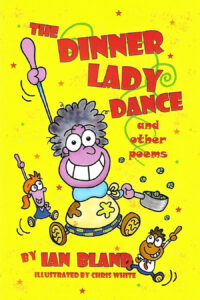
Get yourself a signed book!
🚭 I’ve Hidden Daddy’s Cigarettes
I’ve hidden Daddy’s cigarettes
Because I don’t want him to die.
The teacher says they’re bad for you
And teachers never lie.
I can tell my Daddy wants one
Because his face is growing red.
If he finds out that I’ve done it
Then he’ll send me up to bed.
He’s checked up in the cupboard
And he’s checked behind the chair.
He’s checked beneath the sofa
But he’ll never find them there.
You can see he’s getting cross now
And he shouts “For goodness sakes!”
As the sweat drips from his forehead
And his hands begin to shake.
He thinks he’s got some spare ones
But I’ve hidden that pack too.
He now looks really worried
And doesn’t know what he should do.
He’s looking really desperate
Because the time is after ten.
He can’t go out and buy some
Because the shops are shut by then.
But I feel very happy
Because I’ve done something quite clever.
I’ve stopped my Daddy smoking
And now he’ll live forever.
✨ Activity ideas:
-
Theme discussion: Talk about how humour and rhyme can be used to explore serious issues like health or habits.
-
Writing task: Pupils brainstorm other things they could “hide” to change behaviour (hide phones, sweets, crisps). Write their own rhyming list poems.
-
Language focus: Look at rhyme scheme and rhythm – pupils identify the rhyming pairs.
-
Extension: Pupils write a “serious” version of the poem – what if the narrator talked openly instead of hiding things? Compare humour vs. sincerity.
Link to Kindness Poems 🔗 Teaching Rhythm and Rhyme KS2 🔗 Christmas Card Poems KS2
🏠 The Monster in My House
There’s a monster in my house
He’s very tall and has big shoes.
He has a massive chair
On which he sits to read the news.
He has lots of yellow pointed teeth
And he likes to watch the telly.
He has a deep and slightly scary voice
And his socks are really smelly.
He gets up early every morning
And goes to bed quite late at night.
He sometimes tries to kiss me
But I’m frightened that he’ll bite.
He sometimes tries to chase my mum
And she runs away and squeals.
She’s probably really scared of him
And I know just how she feels.
He has lots of food at mealtimes
And I shout and cry and yell.
Because I’m scared he’ll put me on his plate
And eat me up as well.
But my mum says not to be so daft
He’s really not so very bad.
There’s no monster living in my house
It’s just a man and he’s my dad.
✨ Activity ideas:
-
Twist endings: Explore how the poem leads us to believe one thing but ends with a surprise. Pupils brainstorm their own “disguised” family member poems (sister is a witch, brother is a robot).
-
Character description: Write a stanza describing a “monster family member” using exaggerated adjectives.
-
Performance: Groups perform the poem, adding monster voices and sound effects until the twist ending.
-
Cross-curricular link: Link to Fantasy Poems KS2 for other monster/creature poems.
 🍳 Dad Can’t Cook!
My dad sings like a pop star
And he can speak in French and Dutch,
He can dig and weed the garden
Though he doesn’t do it much,
He can make himself go cross-eyed,
Touch his nose with the tip of his tongue,
But when he tries to cook a meal
It goes very, very wrong!
My dad can juggle oranges
And can climb and swing through trees,
He can jump across our garden pond
With most impressive ease,
He can help me with my homework
When I’m well and truly stuck,
But don’t let him cook dinner because
DAD CAN’T COOK!
✨ Activity ideas:
-
Contrast: Pupils explore how the humour comes from listing skills followed by one big failure.
-
Writing task: Children list 4–6 amazing things their family member can do, then end with one funny weakness.
-
Performance: Stress the final line with actions (shaking head, hands in the air).
-
PSHE link: Discuss how nobody is perfect – everyone has strengths and weaknesses.

✨ Comprehensive activity ideas for teachers:
-
Spot the Refrain
-
Pupils identify the repeated line “My mum is the teacher.”
-
Discuss how repetition builds rhythm, humour, and emphasis.
-
Challenge children to create their own refrain about a family member (e.g. “My brother is a gamer”, “My gran loves her garden”).
-
-
List Poetry Frame
-
Use the poem as a list model: each line begins with “Can’t…”.
-
Pupils brainstorm a list of family rules, complaints, or funny frustrations.
-
Write their own poems where the list builds towards a comic effect.
-
-
Shape Poem Challenge
-
Explore why this is also a shape poem: the layout adds visual humour.
-
Children design their own family-themed shape poems (e.g. dad in the shape of a football, gran in the shape of a teapot, sibling as a phone or tablet).
-
Combines literacy with art and design.
-
-
PSHE Link – Perspective Taking
-
Discuss what it might feel like for the mum in the poem!
-
Children rewrite a few lines from the teacher-mum’s point of view (e.g. “I can’t mark homework quickly / My son is in my class!”).
-
Builds empathy and links to PSHE.
-
-
Performance Extension
-
Groups perform the poem with one pupil acting as “the mum” while others chorus the refrain.
-
Experiment with tone: read it funny, serious, or dramatic — how does the meaning change?
-
📚 Why Use Family Poems in KS2?
Family poems are relatable, funny, and often touching. They help children to:
-
Explore humour and exaggeration 😂
-
Write from personal experience ✍️
-
Develop empathy by imagining others’ perspectives 🤔
-
Perform confidently in front of peers 🎤
👉 For more inspiration, check out:
- 10 Fun Poetry Activities
- Learn how to write a Blackout poem 🔗 Best Poems For Children To Learn And Perform KS2 🔗 Christmas Card Poems KS2

Family life is full of humour, quirks, and everyday dramas. By writing about their families, children learn that poetry can be funny, personal, and creative.
👉 In my Poetry Days in primary schools across the UK I work hard to get the children excited about writing and performing their own poems. I visit over 100 schools every year and I’d love to work with your children and teachers.
📅 You can book me for:
-
In-person Poetry Days across the UK
-
Online Poetry Workshops (affordable and flexible)
➡ Secure your date here: Poets in Schools – Ian Bland