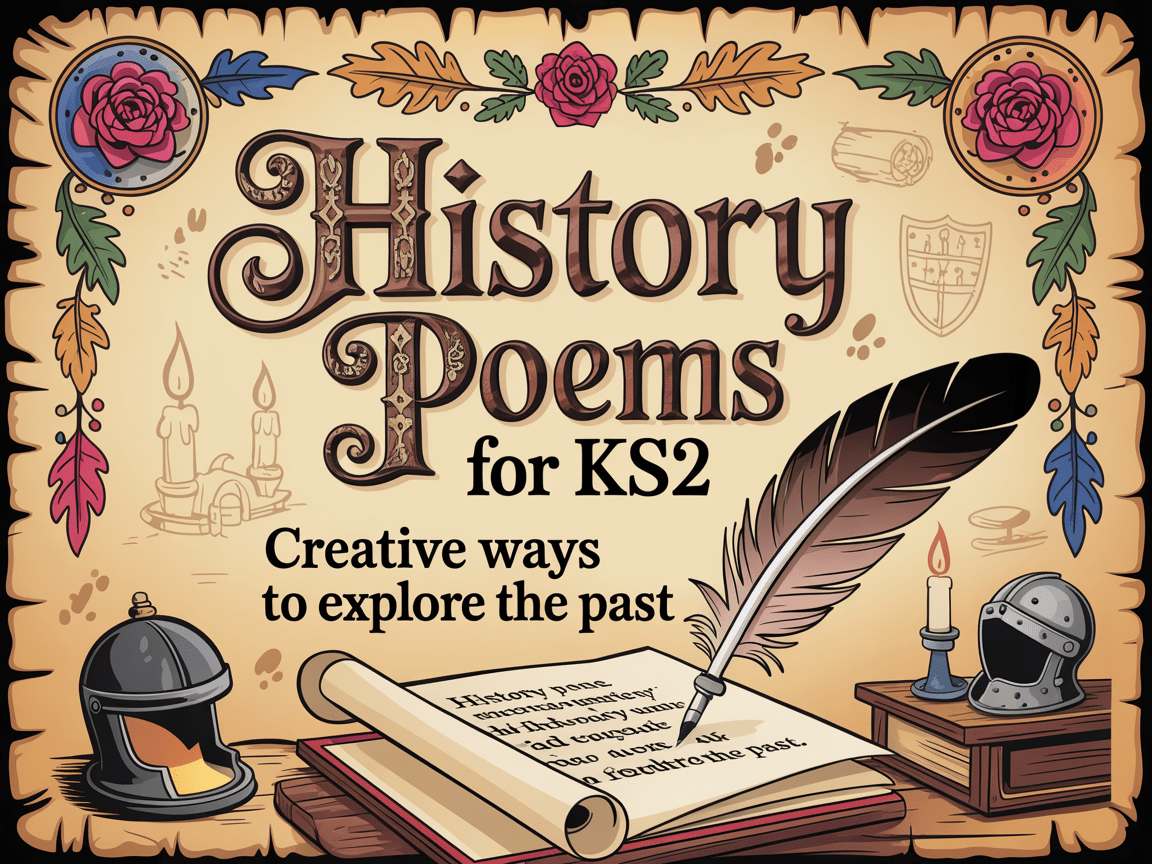
History Poems for KS2: Creative Ways to Explore the Past

Introduction 🌟
History isn’t just dates and facts — it’s stories, voices, and emotions. History poetry KS2 lessons are a powerful way to help children connect with the past. By writing and performing poems about historical events and figures, pupils develop empathy, practise descriptive language, and bring their history learning to life.
🔗 Related: The Ultimate Guide to Teaching Poetry in KS2
If you’d like your pupils to develop their poetry skills, I offer Online Workshops and Poetry Days for KS2 (and KS1).

Great for teachers looking to save time!
Why Use Poetry in History Lessons? 🏰
-
Brings history alive – children step into the shoes of people from the past.
-
Encourages empathy – poetry helps pupils imagine feelings and perspectives.
-
Builds vocabulary – combines historical terminology with figurative language.
-
Cross-curricular learning – links English objectives with History topics.
🔗 Related: Narrative Poems for KS2 • Free Verse Poetry in KS2 👉 Performance Poetry in Primary Schools
🔗 Teaching Figurative Language Through Poetry 🔗 Teaching Rhythm and Rhyme KS2 🔗 Christmas Similes and Metaphors KS2
History Poetry Examples for KS2 📝
The Roman Soldier (Free Verse)
Shield on my shoulder,
Sword in my hand,
Marching to the edge
Of an unknown land.
The Great Fire of London (Free Verse)
Crackling streets,
Flames chasing shadows,
Buckets pass hand to hand —
London burning.
The Suffragette’s Voice (Free Verse)
Chained to the railings,
Words louder than laws,
We will not be silent
Anymore.
Viking Raid (Cinquain)
Vikings,
Fierce, daring,
Rowing, raiding, roaring,
Shadows on the shoreline,
Warriors.
WW2 Evacuee (Haiku)
Suitcase in my hand,
Train whistles into the dark,
Home fades into mist.
These examples show how different poetic forms — free verse, cinquains, and haikus — can all capture moments in history in vivid and memorable ways.
👉 Myths and Legends Poems 🔗 The Ultimate Guide To Teaching Poetry KS2
Fun Classroom Activities 🔍
-
Diary to Poem
Take a diary extract (e.g. Samuel Pepys). Children turn it into a free verse poem, focusing on imagery and emotion. -
Voices from the Past
Assign roles (e.g. Viking raider, evacuee, coal miner). Pupils write a poem in the first person. -
Freeze-Frame Poetry
Create a tableau of a historical scene. Each child writes a line of poetry to describe their character or action. -
Time-Travel Cinquains
Use the cinquain structure to capture a period in history (e.g. “Romans,” “Victorians,” “World War Two”).
History Topics That Work Well for Poetry 🌍
-
Romans – daily life, soldiers, gladiators
-
Vikings – raids, longships, sagas
-
Victorians – schools, factories, inventions
-
WW2 – evacuees, the Blitz, rationing
-
Stone Age to Iron Age – tools, caves, farming
-
Famous figures – Florence Nightingale, Mary Seacole, Neil Armstrong
🔗 Related: List Poems for KS2 • Cinquain Poems for KS2
 Tips for Teachers 👩🏫
-
Provide a bank of topic vocabulary (historical terms + powerful verbs/adjectives).
-
Use artefacts, photos, or video clips to spark descriptive writing.
-
Encourage pupils to perform their history poems in assemblies or class showcases.
-
Link poems to topic writing (letters, diaries, persuasive speeches).
 Final Thoughts 💡
Poetry gives children a unique way to connect with the past. With history poetry KS2, pupils don’t just study history — they experience it, bringing events and voices to life in their own words.
👉 Want to inspire your pupils even more? My Poetry Days in schools include cross-curricular workshops that link perfectly with your history topics. From Romans to Victorians, I’ll show your pupils how to make the past sing through poetry.
Find out more and book a Poetry Day here ➡ Poets in Schools – Ian Bland