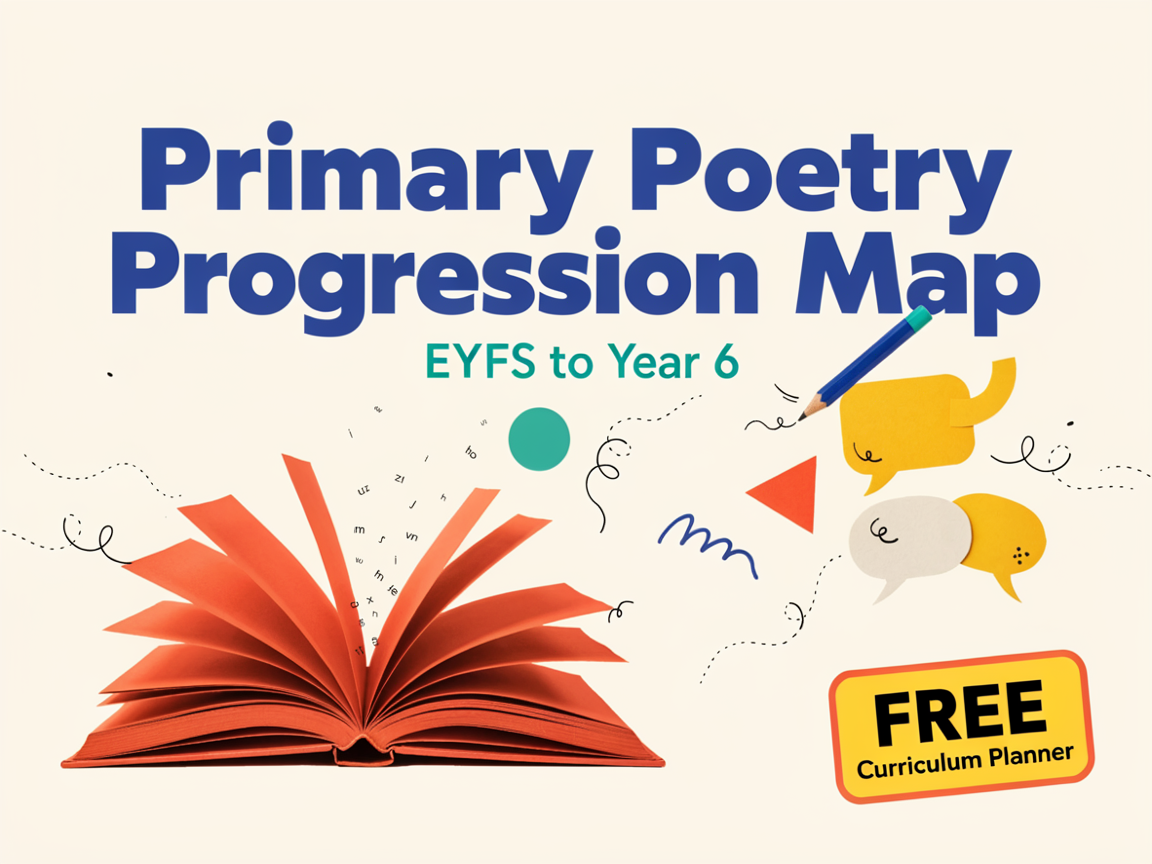
📚 Primary Poetry Progression Map EYFS to Year 6 | FREE Curriculum Planner

👉 Unsure what poetry children should experience in each year group?
👉 Want to stop pupils writing the same acrostic poem year after year?
👉 Need a clear whole-school poetry progression map for teachers, SLT or your English lead?
You’re in the right place.
A strong Primary Poetry Progression Map from EYFS to Year 6 helps schools develop poetry systematically — from joining in with nursery rhymes and repeated refrains to analysing, writing and confidently performing sophisticated poems in Upper KS2.
This guide gives you a practical, flexible poetry progression covering:
- Reading and enjoying poetry
- Discussing language and meaning
- Writing and improving poems
- Learning poems by heart
- Performing with confidence
- Building vocabulary, creativity and pupil voice
Most importantly, it helps poetry become something children experience throughout primary school — rather than a one-off activity during National Poetry Day.
I use this same progressive approach during my Poetry Days and Online Poetry Workshops, adapting activities for pupils from EYFS and KS1 through to Years 5 and 6.
Children don’t just listen to poems. They play with language, collect ideas, write collaboratively, improve their work and perform poems they are proud of.
✅ Poetry Days in Primary Schools
✅ Online Poetry Workshops
➡ Find out more and book here: Poets in Schools – Ian Bland
Funny School Poetry Performance | The Dinner Lady Dance (KS2 Poetry Example)
📘 What Is a Primary Poetry Progression Map?
A poetry progression map shows how pupils’ knowledge, experience and skills develop as they move through school.
It helps teachers answer four important questions:
- What poetry should pupils read and hear?
- What should they notice and discuss?
- What kinds of poems should they create?
- How should their performance skills develop?
A progression map is not simply a list of poetic forms.
Teaching acrostics in Year 2, kennings in Year 3 and cinquains in Year 4 does not automatically create progression.
Real progression happens when pupils become increasingly able to:
- Listen carefully
- Respond personally
- Discuss language
- Choose vocabulary deliberately
- Organise ideas
- Experiment with poetic forms
- Edit for meaning and impact
- Read aloud expressively
- Perform confidently for an audience
That is what this map is designed to support.

Great for teachers looking to save time!
Great for teachers looking to save time!
🎯 Why Primary Schools Need a Poetry Progression Map
Poetry can sometimes become the forgotten part of the English curriculum.
A class might write shape poems at Christmas, perform something for National Poetry Day and then not return to poetry for another year.
Without a whole-school plan, schools can easily experience:
- The same poetic forms being repeated
- Too much emphasis on making poems rhyme
- Very little poetry being read for pleasure
- Performance being treated as an optional extra
- Writing activities without strong model poems
- Pupils completing poetry “worksheets” without developing a poetic voice
- Teachers being unsure what progression actually looks like
A good poetry progression map creates a coherent journey from EYFS to Year 6.
It allows pupils to build upon previous experiences while encountering increasingly rich language, challenging ideas and sophisticated ways of expressing themselves.

📊 What Does the National Curriculum Say About Poetry?
Poetry is an important part of the English curriculum.
In EYFS, children should experience songs, rhymes, poems and stories. They should join in with repeated language, perform with others and begin noticing patterns in words and sounds.
In KS1, pupils should listen to and discuss a wide range of poetry, appreciate rhymes and poems, recognise recurring language and learn some poems by heart.
In KS2, pupils should encounter an increasingly wide range of poetry, recognise different forms, discuss language and meaning, prepare poems for performance and learn a wider range of poetry by heart.
The National Curriculum also expects pupils to perform using appropriate:
- Intonation
- Tone
- Volume
- Expression
- Actions
You can read the complete requirements in the English National Curriculum programmes of study.
The DfE’s Development Matters guidance also recommends sharing traditional and contemporary poetry in EYFS, helping children join in with refrains and encouraging playful experimentation with rhyme.
An important point
The National Curriculum does not prescribe a fixed poetic form for every individual year group.
KS2 requirements are organised in two-year phases:
- Years 3 and 4
- Years 5 and 6
The year-by-year progression below is therefore a practical suggested model, not a statutory checklist. Schools should adapt it to suit their pupils, curriculum and chosen texts.
🌱 EYFS Poetry Progression: Enjoying Sounds, Rhymes and Repetition
At this stage, poetry should be playful, physical, musical and shared.
The objective is not to produce perfectly written poems.
It is to help children:
- Enjoy the sound of language
- Listen and respond
- Join in
- Anticipate repeated words
- Notice rhyme and rhythm
- Experiment with their voices
- Build vocabulary through poems, songs and rhymes
📖 Reading and enjoying poetry
Children should regularly hear:
- Nursery rhymes
- Action rhymes
- Traditional and contemporary poems
- Songs and chants
- Repetitive poems
- Call-and-response poetry
- Poems from different cultures and traditions
Encourage children to:
- Join in with repeated lines
- Supply a missing rhyming word
- Clap or move to the beat
- Copy actions and sound effects
- Talk about favourite words
- Respond to poems through pictures, play and movement
✏️ Creating poetry
Poetry creation in EYFS can be completely oral.
Children might:
- Replace one word in a familiar rhyme
- Invent a silly rhyming pair
- Add a sound to a class poem
- Contribute a line beginning with the same phrase
- Describe something they can see, hear or feel
- Create an action for a word or line
🎤 Performance
Children should have opportunities to:
- Perform rhymes together
- Use actions and facial expressions
- Copy changes in volume
- Join in with call-and-response poems
- Perform for another group or class
Suggested experiences
- Nursery rhymes
- Action rhymes
- Repetitive chants
- Sound poems
- Call-and-response poems
- Simple oral list poems
👉 The key principle for EYFS is:
Hear it. Join in. Play with it. Enjoy it.

🌟 Year 1 Poetry Progression: Joining In and Creating Patterns
In Year 1, pupils should continue to experience poetry orally while beginning to discuss and create simple patterns of their own.
📖 Reading and responding
Pupils should:
- Listen to a wide range of poems
- Join in with predictable phrases
- Recognise obvious rhyming words
- Notice repeated words and lines
- Discuss words they find funny, surprising or interesting
- Link a poem to their own experiences
- Begin learning short poems by heart
Teachers should read poems that are more sophisticated than the texts pupils can yet read independently.
✏️ Writing and creating
Pupils can begin creating:
- Simple list poems
- Repetitive poems
- Patterned poems
- “I can see…” sensory poems
- Class poems
- Simple acrostics
- Two-line rhymes
At this stage, oral composition remains extremely important.
Children may be able to say a much stronger poetic line than they can write independently. Let them rehearse ideas aloud before attempting to record them.
Useful sentence patterns
- I can see…
- I can hear…
- I like…
- In my bag…
- If I were…
- The monster is…
- Down in the playground…
🎤 Performance
Pupils should practise:
- Speaking clearly
- Joining a whole-class performance
- Using simple actions
- Changing volume
- Pausing at the end of a line
- Reciting a short poem from memory
Suggested forms and experiences
- Rhyming couplets
- List poems
- Acrostics
- Repetitive poems
- Action poems
- Call-and-response poems
The emphasis should remain on enjoyment and confidence — not technical perfection.
🌈 Year 2 Poetry Progression: Choosing Words and Performing with Meaning
Year 2 pupils should begin making more deliberate choices about vocabulary and structure.
They should still play with language, but they can now explain some of their choices.
📖 Reading and responding
Pupils should:
- Listen to contemporary and classic poetry
- Express opinions about poems
- Recognise recurring language
- Discuss favourite words and phrases
- Notice rhythm, rhyme and repetition
- Build a repertoire of poems learnt by heart
- Recite poems using appropriate intonation
Encourage children to explain their responses:
- Which line made you laugh?
- Which word created the clearest picture?
- Where did your voice change?
- How did the poem make you feel?
- Which part would be most enjoyable to perform?
✏️ Writing and creating
Pupils should have opportunities to:
- Plan ideas orally
- Collect words before writing
- Use simple writing frames
- Create repeated structures
- Experiment with line breaks
- Write short poems for a clear purpose
- Make simple improvements after reading aloud
- Share their work with a partner
Suggested forms and experiences
- List poems
- Acrostics
- Shape poems
- Simple calligrams
- Rhyming couplets
- Question-and-answer poems
- Repetitive performance poems
- Simple character poems
🎤 Performance
Pupils should begin performing with:
- Clearer expression
- Appropriate volume
- Simple changes in pace
- Pauses that support meaning
- Actions or repeated responses
- Greater independence
By the end of KS1, children should see poetry as something they can read, discuss, write and perform.
🐉 Year 3 Poetry Progression: Exploring Form, Imagery and Performance
Year 3 marks an important transition.
Children should continue enjoying playful poetry while beginning to understand how poets make deliberate choices.
📖 Reading and responding
Pupils should:
- Read and listen to a wide range of poems
- Recognise different poetic forms
- Discuss interesting words and phrases
- Use dictionaries to investigate vocabulary
- Notice how repetition affects a poem
- Identify simple similes and sensory imagery
- Begin explaining how language creates a picture or mood
- Prepare poems to read aloud and perform
✏️ Writing and creating
Pupils should:
- Collect vocabulary before writing
- Study a model poem
- Discuss its structure
- Rehearse lines orally
- Use sensory description
- Choose stronger verbs
- Experiment with similes
- use repetition deliberately
- Begin making conscious choices about line breaks
- Reread and improve their poems
Useful starting points include:
- Animals
- School
- Weather
- Sport
- Monsters
- Nature
- Friendship
- Funny characters
Suggested forms and experiences
- Kennings
- List poems
- Acrostics
- Shape poems
- Simple free verse
- Riddle poems
- Character poems
- Repetitive performance poems
🔗 Related: KS2 Poetry Vocabulary Mats
🔗 Related: Teaching Powerful Verbs Through Poetry
🔗 Related: KS2 Poetry Sentence Stems and Scaffolds
🎤 Performance
Pupils should develop:
- Clear articulation
- Suitable volume
- Awareness of pace
- Expression linked to meaning
- Simple group organisation
- Confidence performing to a class
🏰 Year 4 Poetry Progression: Developing Control and Making Improvements
In Year 4, children should begin moving from simply including poetic techniques to using them for a reason.
A simile should create a clearer picture.
Repetition should add emphasis.
A line break should influence how the poem is read.
📖 Reading and responding
Pupils should:
- Read and discuss a broad range of poetry
- Compare two poems on a similar subject
- Identify different forms
- Explore rhythm and rhyme
- Discuss simile, metaphor and personification
- Infer mood and viewpoint
- Explain how a word or phrase affects the reader
- Rehearse poems for presentation and performance
✏️ Writing and creating
Pupils should:
- Plan ideas using notes or vocabulary banks
- Learn from model poems
- Experiment with imagery
- Use similes and personification
- Select precise nouns and verbs
- Organise ideas into lines and stanzas
- Read drafts aloud
- Give and receive helpful feedback
- Improve vocabulary and structure
- Edit with increasing independence
Suggested forms and experiences
- Free verse
- Narrative poems
- Cinquains
- List poems
- Shape poems
- Personification poems
- Performance poetry
- Poems using a repeated refrain
🔗 Related: Teaching Figurative Language Through Poetry KS2
🔗 Related: KS2 Poetry Editing and Improving
🔗 Related: KS2 Shared Writing for Poetry
🎤 Performance
Pupils should be able to:
- Divide a poem between performers
- Use tone, volume and action
- Vary pace for effect
- Emphasise important words
- Respond to an audience
- Explain their performance choices
🚀 Year 5 Poetry Progression: Voice, Mood and Deliberate Craft
By Year 5, pupils should be reading and discussing more complex poetry.
They should also recognise that poems do not need to follow one fixed formula.
A poem might rhyme — but it does not have to.
A poem might tell a story, explore a feeling, capture a moment or present a powerful viewpoint.
📖 Reading and responding
Pupils should:
- Read an increasingly wide range of poetry
- Compare poems by different writers
- Discuss themes and viewpoints
- Explore figurative language
- Evaluate the effect of vocabulary choices
- Notice changes in mood or tone
- Discuss how structure contributes to meaning
- Learn a wider range of poetry by heart
- Recommend poems to other pupils
✏️ Writing and creating
Pupils should:
- Consider audience and purpose
- Select a suitable form
- Develop a consistent poetic voice
- Create mood and atmosphere
- Experiment with line length and stanza structure
- Use metaphor and personification with increasing control
- Choose vocabulary for precision rather than decoration
- Draft, reread and edit for impact
- Remove unnecessary words
- Explain important creative decisions
Suggested forms and experiences
- Free verse
- Narrative poetry
- Ballads
- Odes
- Dramatic monologues
- Performance poems
- Poems written from a character’s viewpoint
- Poems using extended imagery
🔗 Related: Free Verse Poetry KS2
🔗 Related: Narrative Poems KS2
🔗 Related: KS2 Poetry Model Texts
🎤 Performance
Pupils should be able to:
- Prepare a poem independently
- Use intonation to communicate meaning
- Change tone and volume deliberately
- Perform confidently in a group or individually
- Adapt a performance after receiving feedback
- Explain how performance choices affect an audience
🎓 Year 6 Poetry Progression: Independence, Interpretation and Impact
In Year 6, pupils should bring together everything they have learnt about reading, writing and performing poetry.
The objective is not to produce identical poems containing a checklist of poetic devices.
The objective is for pupils to make increasingly independent and purposeful choices.
📖 Reading and responding
Pupils should:
- Read and discuss increasingly challenging poetry
- Compare poems across themes, forms or periods
- Explore different possible interpretations
- Discuss the impact of figurative language
- Identify how structure contributes to meaning
- Support opinions with evidence
- Recognise tone, voice and viewpoint
- Learn and perform poems by heart
- Recommend poems and poets to others
- Respond thoughtfully to unfamiliar poems
✏️ Writing and creating
Pupils should:
- Choose a form appropriate to their idea
- Establish a distinctive voice
- Control viewpoint and mood
- Use imagery selectively
- Experiment with sound, rhythm and repetition
- Make deliberate structural choices
- Use line breaks and stanza breaks for effect
- Draft and redraft
- Evaluate whether every word earns its place
- Respond constructively to feedback
- Prepare finished work for publication or performance
Suggested forms and experiences
- Free verse
- Narrative poetry
- Ballads
- Dramatic monologues
- Spoken-word poetry
- Parodies
- Poems using sustained or extended metaphors
- Poems inspired by traditional forms
- Poems combining more than one style
🎤 Performance
Pupils should be able to:
- Perform confidently for a real audience
- Use tone, pace, pause, volume and gesture
- Memorise an appropriate poem
- Interpret rather than merely recite
- Work effectively as part of an ensemble
- Give constructive performance feedback
- Adapt their delivery to improve meaning and impact
By the end of Year 6, pupils should understand that poetry is not simply a school exercise.
It is a way of:
- Playing with language
- Communicating ideas
- Expressing emotions
- Exploring identity
- Entertaining an audience
- Making people think
📥 FREE Download: Primary Poetry Progression Map EYFS to Year 6 pdf
📥 Editable Download: Primary Poetry Progression Map EYFS to Year 6 (Word Version)
To save teachers and English leads time, I have created a complete Primary Poetry Progression Map from EYFS to Year 6.
The ready-to-use resource includes:
✔ Reading and enjoyment progression
✔ Poetry discussion and vocabulary progression
✔ Writing and composition progression
✔ Performance and oracy progression
✔ Suggested poetic forms for every year group
✔ Whole-school poetry provision audit
✔ Space for schools to add their chosen poems and poets
It can be used for:
- Whole-school English planning
- Subject-leader monitoring
- Staff meetings
- Curriculum reviews
- Book and planning scrutiny
- Poetry CPD
- Supporting ECTs and non-specialist teachers
🧠 A Simple Whole-School Poetry Model
A strong poetry curriculum should contain four connected strands:
1️⃣ Read and Enjoy
Children regularly hear excellent poetry without always having to complete a written task.
2️⃣ Explore and Discuss
Pupils talk about vocabulary, imagery, sound, structure, ideas and personal responses.
3️⃣ Create and Improve
Children borrow techniques from model poems, develop their own ideas and improve their work.
4️⃣ Rehearse and Perform
Pupils bring poems alive through voice, expression, movement and collaboration.
If one strand is missing, poetry provision becomes weaker.
For example:
- Writing without reading limits pupils’ models.
- Analysis without enjoyment can make poetry feel lifeless.
- Writing without performance removes its natural audience.
- Performance without discussion can become noisy but superficial.
The four strands should work together.
🔍 Whole-School Poetry Audit Questions
English leads can use these questions to review current provision:
- Does every year group encounter poetry regularly?
- Are pupils introduced to contemporary and classic poets?
- Do the chosen poems reflect different cultures, backgrounds and experiences?
- Is poetry read for pleasure as well as studied?
- Do pupils learn poems by heart?
- Does performance develop progressively?
- Are pupils exposed to a variety of poetic forms?
- Are teachers using strong model poems?
- Do pupils have opportunities to edit and improve?
- Are reluctant writers properly supported?
- Are more confident writers challenged to make independent choices?
- Is poetry celebrated through assemblies, displays or performances?
- Can pupils talk enthusiastically about poems and poets?
The purpose is not to create extra paperwork.
It is to identify:
- What is already working
- Where unnecessary repetition occurs
- Which experiences pupils are missing
- What the school should improve next
⚠️ Five Common Poetry Curriculum Mistakes
1. Teaching poetry only once a year
Poetry should reappear regularly through reading, writing and performance.
2. Expecting every poem to rhyme
Rhyme is valuable, but forcing rhyme often leads to strange sentences and poor vocabulary choices.
3. Teaching forms without purpose
Children need to understand why a particular form suits an idea — not simply complete a template.
4. Analysing every poem to death
Sometimes children should hear a poem, enjoy it and ask to hear it again.
That is a worthwhile outcome.
5. Forgetting performance
Poetry is meant to be heard.
Reading aloud helps pupils understand rhythm, meaning, emphasis and the effect of their vocabulary choices.
🔗 Related: Performance Poetry in Primary Schools
🔗 Related: Best Poems for Children to Learn and Perform
👩🏫 Supporting SEND, EAL and Reluctant Writers
Progression does not mean every child must produce exactly the same outcome.
Teachers can provide support through:
- Oral rehearsal
- Shared writing
- Picture prompts
- Vocabulary mats
- Sentence stems
- Repeated structures
- Adult scribing
- Partner composition
- Movable word cards
- Group performance
The underlying poetic objective can remain ambitious while the route into the activity is adapted.
🔗 Related: KS2 Poetry Sentence Stems and Scaffolds
🔗 Related: Poetry for Reluctant Writers KS2
🔗 Related: KS2 Poetry Planning Templates
📊 Assessing Progress Without Killing Creativity
Poetry assessment should focus on development — not counting features.
Avoid marking a poem by asking:
- Does it contain three similes?
- Does every line rhyme?
- Has the pupil used an adjective?
- Is it exactly twelve lines long?
Instead, consider whether the pupil is becoming more able to:
- Generate ideas
- Select vocabulary
- Create images
- Organise a poem
- Make deliberate structural choices
- Communicate a mood or viewpoint
- Improve a draft
- Explain creative decisions
- Read aloud expressively
- Respond to other poems
A cold write and later independent poem can provide clear evidence of progress without covering the work in corrections.
🔗 Related: KS2 Poetry Cold Writes and Baseline Assessment
🔗 Related: KS2 Poetry Assessment Made Simple
🌟 Final Thoughts
A strong Primary Poetry Progression Map from EYFS to Year 6 does not turn poetry into a rigid checklist.
It does the opposite.
It gives teachers the confidence to provide pupils with:
- Better poems
- Richer language
- More varied experiences
- Clearer progression
- Greater creative freedom
- Regular opportunities to perform
Children begin in EYFS by joining in with rhymes, actions and repeated phrases.
They leave Year 6 able to read, discuss, write, edit, interpret and perform poetry with confidence and independence.
That is real poetry progression.
And, most importantly, it allows children to discover that poetry belongs to them.
📣 Bring Whole-School Poetry Progression to Life
A progression map gives your school the plan.
A live poetry experience gives children and teachers the inspiration to put it into action.
Through my Poetry Days and Online Poetry Workshops, I help pupils:
✅ Enjoy funny, accessible poetry
✅ Build ambitious vocabulary
✅ Generate original ideas
✅ Write collaboratively and independently
✅ Edit and improve their poems
✅ Develop speaking, listening and performance skills
✅ Perform with confidence and pride
I have worked with primary schools across the UK and internationally for over 25 years, helping children and teachers discover how exciting poetry can be.
✅ Book a Poetry Day in Your Primary School
✅ Join an Online Poetry Workshop
➡ Find out more, check availability or book here: Poets in Schools – Ian Bland