Teaching Powerful Verbs Through Poetry: Mrs Jardine ✍️⚡

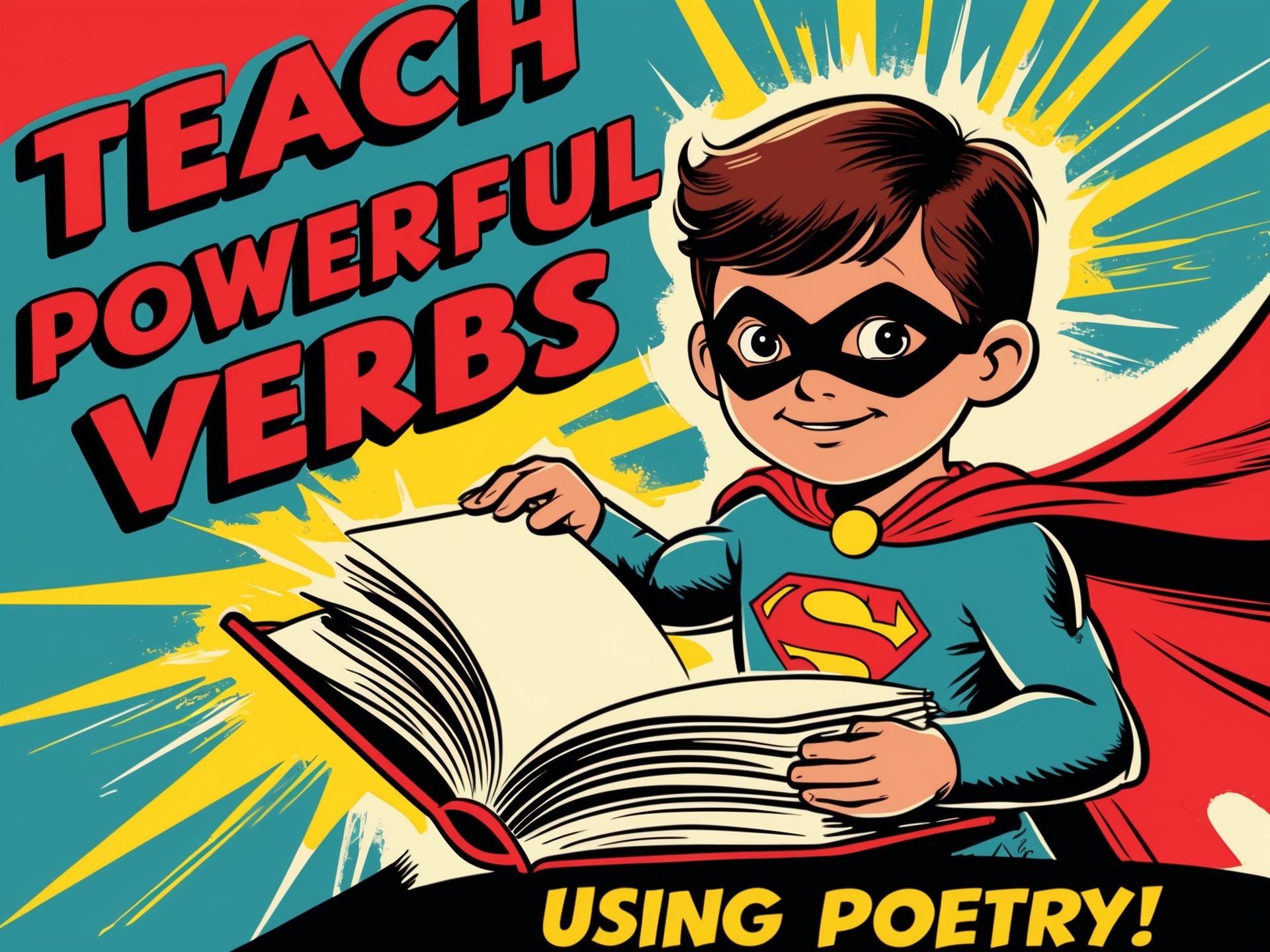

Sometimes poetry can help us get to the heart of a literacy lesson far quicker than prose. The short, sharp rhythm, the sound patterns, and the humour grab children’s attention instantly.
I wrote the poem Mrs Jardine (below) with the teaching of powerful verbs in mind, and it proved a big hit with a Year 5 class I trialled it with recently.
 👉 In my Poetry Days in primary schools across the UK I work hard to get the children excited about writing and performing their own poems. I visit over 100 schools every year and I’d love to work with your children and teachers.
📅 You can book me for:
-
In-person Poetry Days across the UK
-
Online Poetry Workshops (affordable and flexible)
➡ Secure your date here: Poets in Schools – Ian Bland
 Mrs Jardine 🖊️
Mrs Jardine doesn’t smile
She grins,
Mrs Jardine’s got a dozen
Chins.
Mrs Jardine doesn’t sing
She howls,
Mrs Jardine looks at you and
Scowls.
Mrs Jardine doesn’t talk
She barks,
Mrs Jardine’s fingers shoot out
Sparks.
Mrs Jardine doesn’t mark
She scribbles,
Mrs Jardine’s got a mouth that
Dribbles.
Mrs Jardine doesn’t drink
She slurps,
Mrs Jardine likes to loudly
Burp.
Mrs Jardine doesn’t walk
She staggers,
Mrs Jardine’s drawer is full of
DAGGERS!
👉 Mrs Jardine Poem Download 👉 Download: Mrs Jardine Powerful Verb Writing Framework 👉 Funny Christmas Poems KS2
👉 Poetry In The Creative Curriculum 👉 Christmas Shape Poems 👉 KS2 Character Poems 🔗KS2 Frozen Inspired Winter Poems
🔗 7 Creative Poetry Starters For KS2 🔗 KS2 Poetry Vocabulary Mats 🔗 KS2 Poetry Comprehension Worksheets
🔗 KS2 Poetry Planning Templates 🔗 KS2 Poetry Editing & Improving 🔗 KS2 Poetry Assessment Made Simple

Get yourself a signed book!
Step 1: Reading and Responding 📖
After reading the poem with the class a couple of times, ask the children:
-
What kind of teacher is Mrs Jardine?
-
Would you like her as your teacher? Why not?
-
Which verbs tell us the most about her character?
Children quickly spot how swapping an ordinary verb (smile, sing, talk) for a more powerful one (grin, howl, bark) completely changes the mood.
👉 For more fun ideas using humour, see Best Funny Poems for KS2 Children. 🔗 KS2 Shared Writing For Poetry
🔗 KS2 Poetry Lesson Plans (Ready To Use) 🔗 Ready-Made KS2 Poetry Model Texts 🔗 KS2 Poetry Sentence Stems and Scaffolds
Step 2: Exploring Powerful Verbs 💡
Guide a discussion around verb choice:
-
What’s the difference between “smile” and “grin”?
-
How is “bark” stronger than “talk”?
-
Why does “stagger” give us a clearer picture than “walk”?
This naturally shows how word choice creates tone, humour and vivid imagery.
👉 Another fun way to build vocabulary is through Creative Classroom Challenges.
Fun Activities to Extend the Lesson 🎭
1. Performance with Actions & Sounds
Encourage the class to perform the poem together, emphasising the sounds of the verbs.
-
Children can bark, howl, slurp, stagger dramatically.
-
Add sound effects (fingers clicking for sparks, chairs scraping for daggers).
-
Try a “choral reading” where different groups act out different stanzas.
👉 More on this in Performance Poetry in Primary Schools. 👉 Advert Poems 👉 Shape Poems KS2
🔗 Christmas Similes and Metaphors KS2 🔗 Teaching Rhythm and Rhyme KS2 🔗 KS2 Poetry Sentence Stems and Scaffolds

2. Verb Swap Game 🪜
On the board, write weak verbs (smile, talk, walk, eat, drink). Challenge the class to generate as many powerful alternatives as possible (beam, snarl, stagger, gobble, gulp).
Turn it into a “Verb Ladder”: the higher up the ladder, the more powerful the verb!

3. Write Your Own “Doesn’t / Does” Verses ✍️
Ask children to invent their own teacher or character using the same rhythm and rhyme:
Mr Green doesn’t sing
He screeches
Mr Green keeps slimy pet
Leeches…
Mr Green doesn’t run
He races
Mr Green can make fearsome
Faces…
👉 Download: Mrs Jardine Powerful Verb Writing Framework
Encourage them to play with verb pairs and rhyme while keeping the humorous tone.
👉 For other structured models, try I’ve Never Seen… A Fun Way to Teach Rhythm and Rhyme.
4. Mrs Jardine’s Opposite!
Challenge children to write a contrasting poem:
-
What would a kind, gentle teacher do instead?
-
Swap in positive verbs: smiles, sings, chats, dances, skips.
-
Compare the two poems and discuss how verbs change the character completely.
5. Illustrated Anthology 🎨
Get pupils to illustrate their funniest verses – a teacher with sparks flying from her fingers, or slurping noisily in the staffroom! Collect them into a class anthology or display on a “Powerful Verbs Wall.”
6. Hot-Seating Mrs Jardine 🎭
Choose a pupil to be “Mrs Jardine” in the hot seat. The rest of the class asks questions, and the pupil answers using powerful verbs and dramatic expressions. This brings character voice and verbs to life.
7. Verb Detective Challenge 🔍
Give each child a highlighter and re-read the poem. Their task: highlight all the verbs. Then ask them to sort them into “weak” vs “powerful” lists. This reinforces grammar in a fun and memorable way.
Step 3: Writing and Sharing ✨
Once children have written their own verses, invite them to perform to the class. The humour, rhythm and sound effects mean they’ll forget they’re “working on grammar” – and instead will have a blast playing with language.
👉 You’ll find more playful activities in my 10 Fun Poetry Activities for KS2.
 Final Thought 🌟
Mrs Jardine shows children the power of word choice. By swapping weak verbs for strong, funny, and dramatic ones, they see instantly how verbs create character and tone.
And best of all, they’ll be laughing and performing while secretly doing some very serious grammar work!
👉 A ready-to-use mrs-jardine-framework is available to support this activity.
For over 25 years, I’ve been inspiring children to love poetry through laughter, rhythm, and performance. In a Poetry Day, I:
-
Perform high-energy poems (like The Dinner Lady Dance and Chips) in assembly 🎭
-
Lead writing workshops where children create their own food poems ✍️
-
End the day with group performances that make every child feel proud 🌟
📅 You can book me for:
-
In-person Poetry Days anywhere in the UK
-
Online Poetry Workshops for flexible, affordable access — perfect if travel is tricky or you’d like to involve multiple classes at once
👉 Dates around World Book Day and National Poetry Day fill quickly, so book early.
Find out more here ➡ Poets in Schools – Ian Bland