Twist Your Tongue! Why Tongue Twisters Belong in Your Poetry Lessons

Next time you plan a poetry unit, don’t forget to set aside some time for tongue twisters. The National Curriculum encourages us to explore a wide variety of fun poetic forms, and tongue twisters tick all the boxes: they’re playful, memorable, great for performance, and they get children thinking deeply about sound, rhythm, and word choice.
Children love them. They love trying them out, stumbling over them, and laughing with (and at!) each other as they practise. Tongue twisters bring immediate energy and fun to a poetry session.
If this activity would suit your class, you can bring me into your school with an Online Poetry Workshop or a lively Poetry Day.
👉 For another simple but powerful activity, try I’ve Never Seen… A Fun Way to Teach Rhythm and Rhyme.
📚 More Ideas: Poetry Teaching Ideas (144+ KS2 poetry activities)
Try this classic from Fox in Sox by Dr. Seuss:
Through three cheese trees three free fleas flew.
While these fleas flew, freezy breeze blew.
Freezy breeze made these three trees freeze.
Freezy trees made these trees’ cheese freeze.
That’s what made these three free fleas sneeze.
Performance and Challenge
Tongue twisters aren’t just for reading—they’re for performing. In my classroom, we’ve held:
Fastest Performance Competitions – who can say it perfectly at top speed?
Personal Best Charts – children record their best times and challenge themselves to improve.
Visitor Challenges – nothing delights a class more than watching a passing teacher or headteacher trip over their words!
Here’s another favourite:
Peter Piper picked a peck of pickled peppers.
Did Peter Piper pick a peck of pickled peppers?
If Peter Piper picked a peck of pickled peppers,
Where’s the peck of pickled peppers Peter Piper picked?
👉 For more fun performance ideas, see Performance Poetry in Primary Schools.
👉 Advert Poems 👉 KS2 Character Poems 🔗KS2 Frozen Inspired Winter Poems 👉 Winter Poetry KS2 👉 Funny Christmas Poems KS2
🔗 7 Creative Poetry Starters For KS2
Writing Their Own
Once children have tried lots of examples, they’ll be eager to invent their own. This is where the real learning happens. Writing tongue twisters encourages careful thought about:
Word selection – finding words that are tricky to say together.
Sound and rhythm – experimenting with alliteration, rhyme, and pace.
Humour and creativity – the sillier the better!
Here’s a classic:
Betty Botter bought some butter,
“But,” she said, “this butter’s bitter.
If I bake this bitter butter,
It will make my batter bitter…”
With support, even younger KS2 pupils can craft simple one-liners:
If two witches were watching two watches, which witch would watch which watch?
Older or more confident writers can build ambitious full-length twisters:
How much wood could Chuck Woods’ woodchuck chuck,
if Chuck Woods’ woodchuck could and would chuck wood?
👉 Need more playful starters? Try Quick & Easy Poetry Starters for KS2. 🔗 Teach Narrative Poetry KS2
Extra Activities to Try with KS2 (Ages 7–11)
✨ Tongue Twister Tournament – Organise a class competition. Knockout rounds until a champion is crowned.
✨ Tongue Twister Drama – Turn them into short drama skits. Mime Peter Piper picking peppers or witches peering at watches.
✨ Illustrated Anthology – Collect original twisters into a class book with doodles and cartoons.
✨ Tongue Twister Rap – Add a beat or body percussion and perform like a rap.
✨ Challenge Wall – Display the best ones and invite parents or other classes to have a go.
👉 For more ways to mix performance and fun, see Creative Classroom Challenges.
Why They Matter
Tongue twisters aren’t just a bit of fun—they’re brilliant for:
Building fluency and expression in reading
Developing children’s confidence in performance
Encouraging playfulness with language
Creating laughter, energy, and memorable classroom moments
So, next time you’re planning poetry, give tongue twisters a go. They’re quick, accessible, and guaranteed to bring smiles to every face in the room. And who knows—you might even discover your next class champion tongue-twister!
👉 Looking for more fun? Try these 10 Fun Poetry Activities for KS2 Classrooms. 🔗 Teaching Powerful Verbs Through Poetry
Check out this YouTube video which shows children in the USA attempting to read some fun tongue twisters with very amusing results:
https://www.youtube.com/watch?v=8GxDF4IGBKY
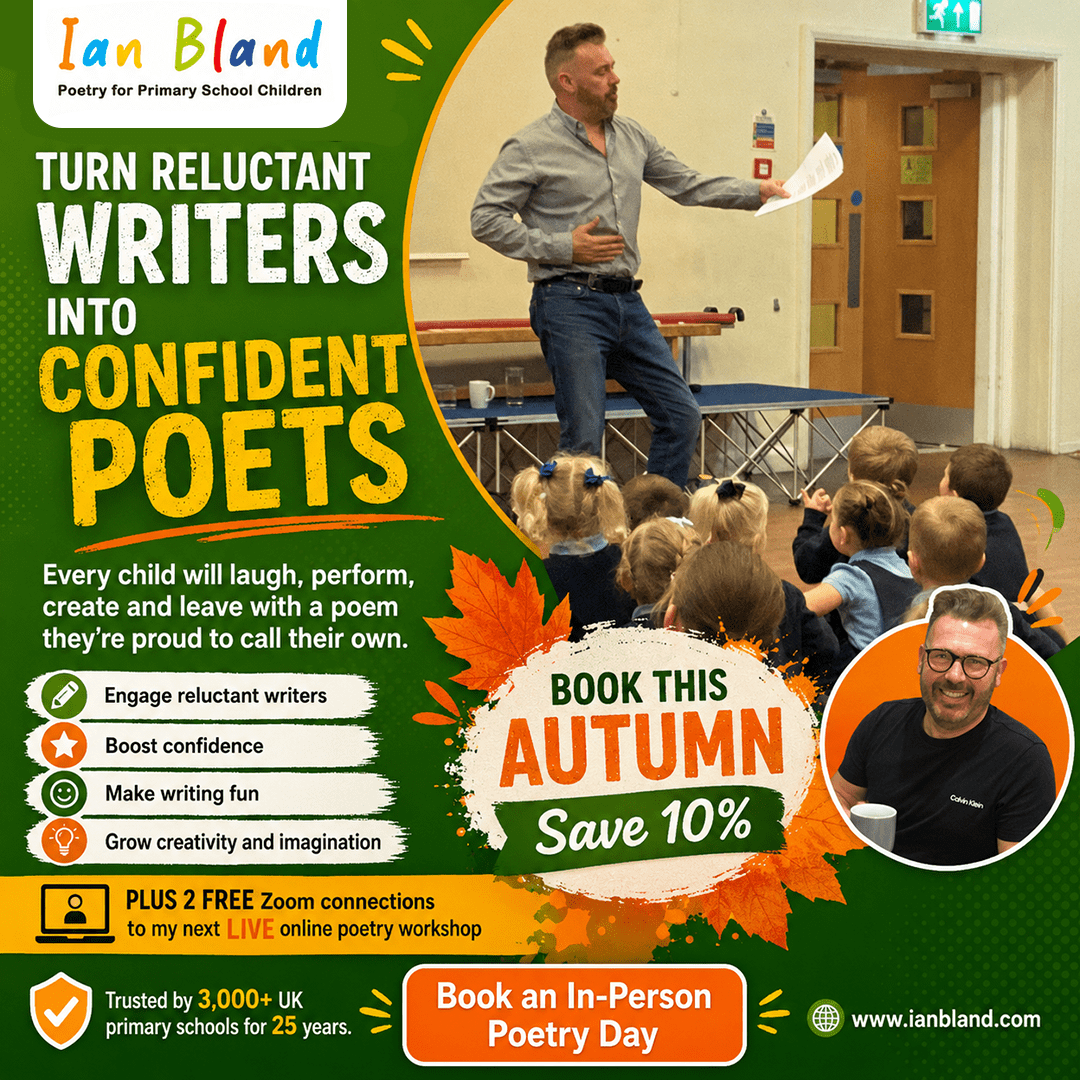
👉 In my Poetry Days in primary schools across the UK I work hard to get the children excited about writing and performing their own poems. I visit over 100 schools every year and I’d love to work with your children and teachers.
📅 You can book me for:
In-person Poetry Days across the UK
Online Poetry Workshops (affordable and flexible)